
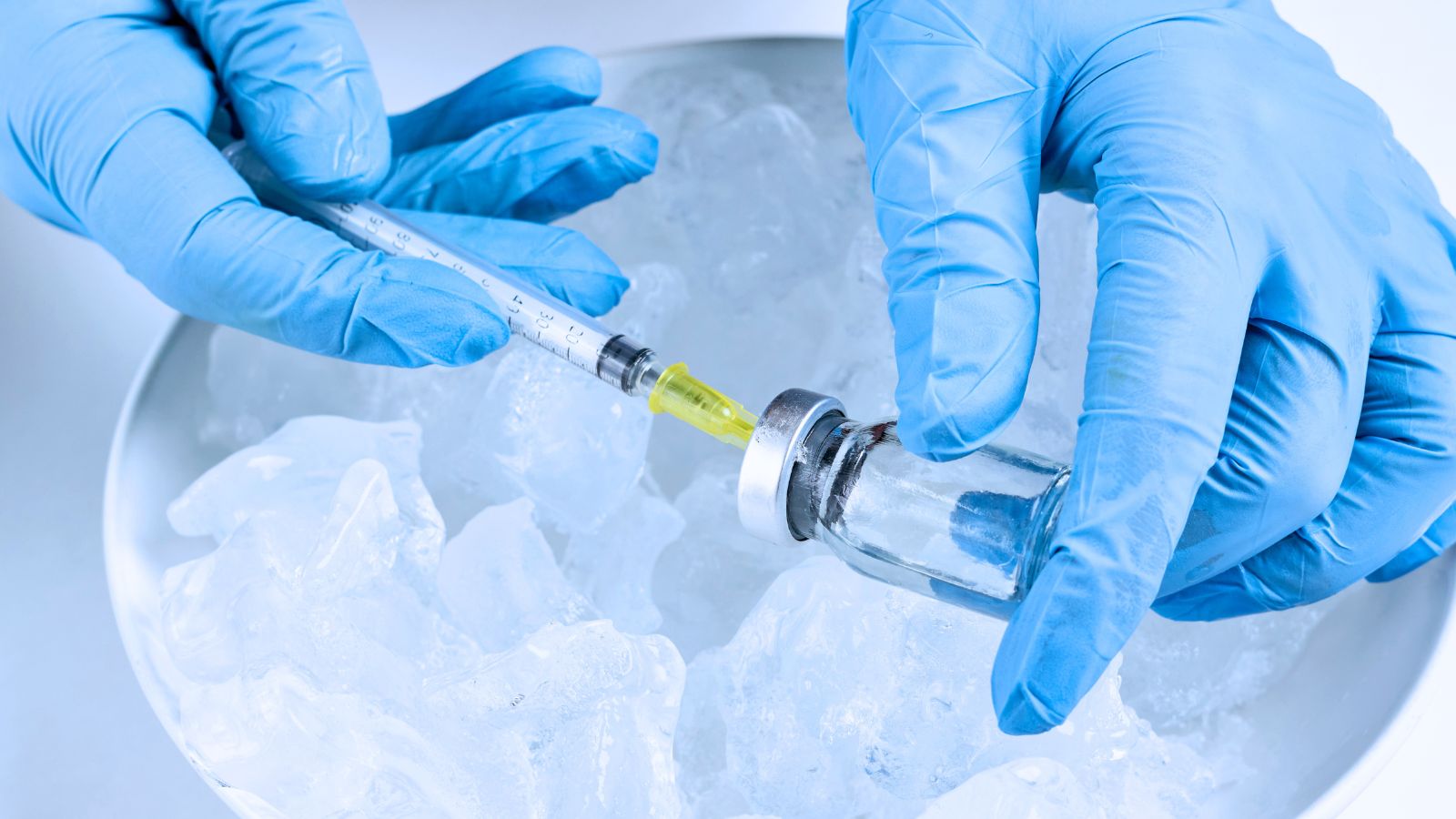
Stated shelf life assumes conditions that rarely hold in a working laboratory. This covers what actually degrades a peptide, what a freeze thaw cycle costs, and how to structure storage so the question stops arising.
What shelf life on a certificate means
It is the period the manufacturer expects the sealed, lyophilised vial to remain within specification when held continuously at the stated storage condition, from the date of manufacture.
Three things in that sentence are load bearing. Sealed. Lyophilised. Continuously.
A vial that has been opened, reconstituted, or allowed to warm repeatedly is outside the conditions the figure describes. The remaining life is shorter by an amount nobody can calculate for you.
What actually degrades a peptide
In rough order of how often it causes problems:
Moisture
Lyophilised peptides are hygroscopic. An opened vial pulls water out of the air, and water enables the hydrolysis reactions that break peptide bonds. This is why a vial should reach room temperature before opening, since opening a cold vial in a warm room condenses moisture directly onto the material.
Temperature cycling
Not simply temperature, but repeated movement across the freezing point. Ice crystal formation and the concentration of solutes that accompanies it is what damages the molecule, and it happens on every cycle.
Oxidation
Sequences containing methionine, cysteine or tryptophan are vulnerable to oxidation on air exposure. Glutathione is the clearest example in most catalogues: its free cysteine oxidises readily, which is why solutions are prepared fresh rather than stored.
Light
Cumulative and slower than the others. Relevant over weeks of storage, largely irrelevant over the minute a vial spends on a bench.
Mechanical stress
Shaking, vortexing and sonication. Visible as foaming, which forms at the air-liquid interface where the peptide is denaturing.
What a freeze thaw cycle costs
There is no single number, because it depends on the sequence, the concentration, the solvent and how fast the transition happens. But the shape of the answer is consistent.
One or two cycles is generally tolerable and most protocols assume it. By five or six you are working with something meaningfully different from what the certificate describes, and the change is invisible: no cloudiness, no colour shift, nothing you would notice by looking.
That invisibility is the problem. Degradation from freeze thaw shows up as a drifting result rather than an obvious failure, which makes it difficult to diagnose after the fact.
Aliquoting
This is the answer to almost all of it. Split the reconstituted solution into single use volumes immediately after reconstitution, before anything goes into a freezer.
Each working session then thaws one aliquot and the remaining material stays untouched at one cycle rather than accumulating. Ten minutes of work once, and the freeze thaw question stops applying.
Practical points:
- Size aliquots to a single session rather than a single experiment, so nothing is thawed and partly used
- Label every tube with compound, concentration and date
- Use low binding tubes for dilute solutions, since peptides adsorb to plastic and a dilute solution can lose a meaningful proportion to the tube wall
- Thaw at room temperature or on ice rather than in a warm hand or a water bath
Lyophilised versus in solution
The difference is larger than most people expect.
A sealed lyophilised peptide at minus twenty degrees will comfortably hold its stated shelf life, frequently longer. The same peptide in solution at four degrees may be usable for weeks. In solution at room temperature, days.
Where a protocol allows it, reconstitute only what you need and leave the rest lyophilised.
Judging a compound that has been mishandled
The useful question is not whether it has expired but whether it still behaves as expected.
If a vial has been through more cycles than you would like, or spent an unknown period out of storage, run a control before committing it to a real experiment. That is a faster and more reliable answer than any calculation about remaining shelf life, and it tells you about the material you actually have rather than the material the certificate describes.
Storage at a glance
- Sealed lyophilised, frozen. Full stated shelf life
- Sealed lyophilised, refrigerated. Shorter, and appropriate for compounds specified that way rather than as a substitute for freezing
- Reconstituted, frozen in aliquots. Weeks to months depending on compound
- Reconstituted, refrigerated. Days to weeks
- Reconstituted, room temperature. Use the same session
Conditions for each compound are on its product page, because they differ and the group is not a reliable guide.