Purity is the number every supplier leads with and the one most open to interpretation. Two certificates quoting 99 percent can describe materially different compounds. This explains why, and what to ask instead.
What HPLC purity measures
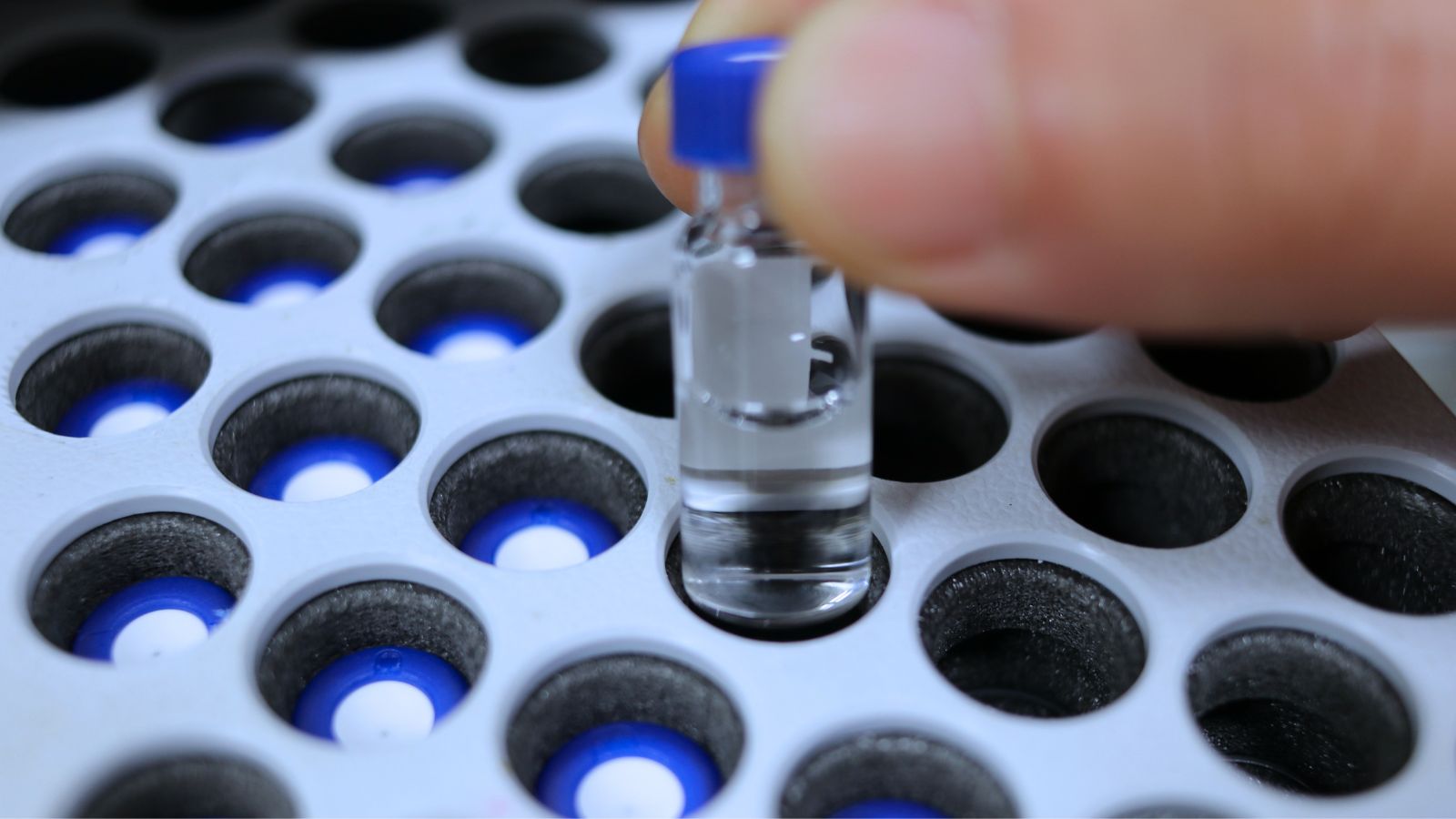
High performance liquid chromatography separates a mixture by pushing it through a column. Components move at different speeds and emerge at different times, and a detector records what comes off.
The result is a trace with peaks. The purity figure is the area under the main peak expressed as a percentage of total integrated peak area.
So a 99 percent figure means: of everything the detector recorded, 99 percent of the signal came from one peak.
Why that is narrower than it sounds
Three limitations, none of which are usually stated.
The detector only sees what it can see
Peptide HPLC typically uses UV detection at 214 nanometres, which responds to the peptide bond. Anything without a strong absorbance at that wavelength contributes little or no signal. It is present in the vial and largely absent from the calculation.
A certificate that does not state the detection wavelength is quoting a figure you cannot interpret.
It is a proportion of detected material, not of the vial
A lyophilised peptide is not pure peptide by mass. It also contains:
- Residual water. Peptides are hygroscopic. Five to ten percent by mass is normal.
- Counterion. Usually trifluoroacetate or acetate from the purification step. Can be ten to twenty percent by mass.
- Residual solvent. Small quantities from synthesis and purification.
None of that appears in an HPLC purity figure. A vial of 99 percent pure peptide might be seventy to eighty percent peptide by mass, and both statements are true at once.
The measurement that captures this is net peptide content, usually by amino acid analysis or nitrogen determination. It is rarely supplied and worth asking for if your work depends on accurate mass.
The method changes the answer
Purity depends on the column, the gradient, the run time and the integration parameters. A shallow gradient over a long run separates closely related impurities into distinct peaks. A steep gradient over a short one lets them co-elute with the main peak, where they are counted as part of it.
Neither is dishonest. But the second produces a higher number from the same material, and if the method is not stated you cannot tell which you are looking at.
What to ask instead
Rather than comparing headline percentages between suppliers, ask:
- What detection wavelength was used
- What the gradient and run time were
- Whether net peptide content is available
- What the counterion is
- Whether the certificate is for the batch you will receive
A supplier who can answer those is running real analysis. A supplier who cannot may still be selling perfectly good material, but you are trusting rather than verifying.
Where mass spectrometry fits
HPLC tells you how much of one thing is present. Mass spectrometry tells you what that thing is. They answer different questions and a certificate needs both.
A pure sample of the wrong compound produces an excellent HPLC purity figure. Only the mass identifies it.
What purity level you actually need
Higher is not automatically better value. The right question is what your assay tolerates.
- Cell culture and biochemical assays. 95 percent and above is generally sufficient, and the identity confirmation matters more than the last two percent.
- Quantitative work where mass matters. Net peptide content becomes more important than HPLC purity.
- Work sensitive to related impurities. A truncated or deletion sequence with similar activity is a bigger problem than an inert one, and only a detailed impurity profile tells you which you have.
Paying for 99 percent where 95 would do is a common way to spend a budget without improving an experiment.
Reading it on a certificate
The certificate walkthrough covers where each of these appears on the page and what to check first.