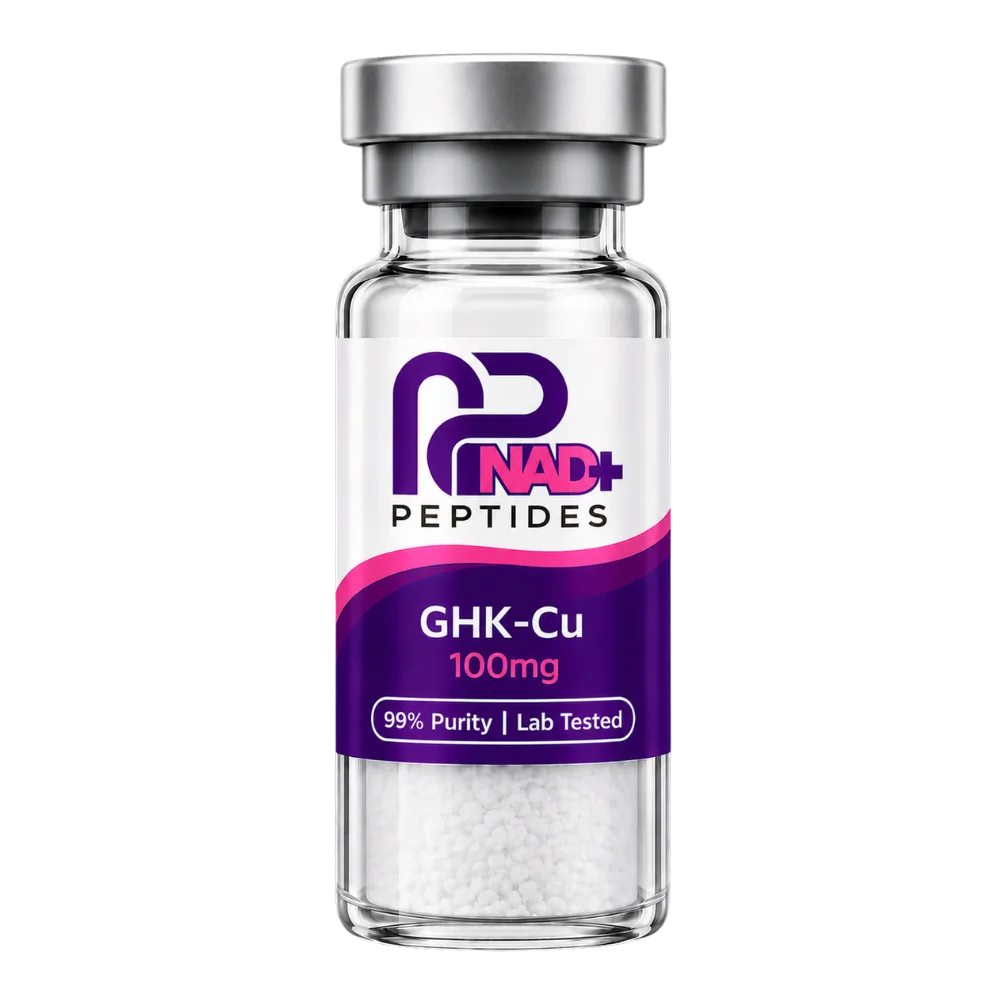
GHK-Cu 100mg
Identity
- CAS number
- 49557-75-7
- Molecular formula
- C14H24N6O4Cu
- Molecular weight
- 403.94
- Sequence
- Gly-His-Lys, copper complexed
Physical form
- Appearance
- Blue lyophilised powder
- Purity
- 99%+ (HPLC)
- Solubility
- Soluble in water
Handling
- Storage
- -20C, protected from light
- Shelf life
- 24 months from date of manufacture, sealed
Also known as Copper tripeptide-1, GHK copper, Gly-His-Lys copper
£38.00
Copper tripeptide complex, 100mg. Arrives as a blue powder, which is the copper complex and is normal.
25 in stock
Supplied for laboratory research use only. Not for human or veterinary use.
- Dispatch Same day if you order before the cut off, tracked all the way
- Documentation Your batch certificate lands in your inbox the moment it ships
- Storage -20C, protected from light
Product description
A naturally occurring tripeptide, Gly-His-Lys, complexed with copper. Supplied lyophilised in a 100mg vial.
Research context
GHK-Cu is the best characterised compound in the cellular research group and has a long published history. Research using it covers extracellular matrix remodelling, collagen synthesis in culture and, more recently, its effects on gene expression across a wide set of transcripts. The copper complex is integral to its activity rather than a carrier.
Handling notes
This compound arrives as a distinctive blue powder rather than the white cake you get with every other peptide here. That is the copper complex and is entirely normal, not a contaminant or a sign of degradation. It is water soluble and dissolves readily. Store frozen and protected from light. Copper complexes are sensitive to chelating agents, so check your buffer composition before use.
Worth knowing
Also referenced as copper tripeptide-1 and as GHK copper. It appears in the combined Glow and Klow preparations alongside other peptides.
Documentation
This batch ships with its own certificate of analysis showing HPLC purity and mass spectrometry identity confirmation. The batch reference is recorded against your order, so a result generated months from now can be traced back to this specific lot.
Intended use
Supplied strictly for laboratory research use. Not a medicine. Not for human or veterinary consumption, and not for any diagnostic or therapeutic use.
Research background
The short version
One of the most studied peptides we stock, and a favourite in skin and tissue research. GHK is a short three amino acid chain that carries copper into cells, which matters because copper is needed to build connective tissue and to run the body's antioxidant enzymes.
GHK-Cu is among the most extensively studied peptides in this catalogue, with a literature running back to the early 1970s. It is the copper(II) complex of the tripeptide glycyl-L-histidyl-L-lysine, and most of the research interest follows from one property: its unusually high affinity for copper, which lets it act as a carrier for an ion that cells otherwise keep under tight control.
Where it came from
First isolated from human plasma in 1973 by Pickart and Thaler, who were investigating why serum from younger donors appeared to affect cultured liver tissue differently from age matched serum. The active factor was identified as GHK. Plasma concentration in humans is reported to decline substantially between early and later adulthood, which is the observation most of the subsequent longevity oriented research is built on.
How it is thought to work
GHK binds copper(II) with very high affinity, comparable to albumin, the plasma protein that normally transports copper. This lets the complex deliver copper to cells for copper dependent processes including connective tissue formation and antioxidant defence.
The more distinctive finding is breadth rather than specificity. Gene expression analyses report GHK modulating a large fraction of analysed human genes, concentrated in tissue repair, antioxidant and anti-inflammatory pathways. The commonly cited figure is in the region of four thousand genes. It is worth reading that number carefully: it describes transcriptional change in cultured cells, not a demonstrated outcome in an organism.
What it is studied for
What the published research found, and what it was tested in. We list the model against each one so you can judge how far the findings go.
- Extracellular matrix remodelling Stimulation of collagen and glycosaminoglycan synthesis, and modulation of matrix metalloproteinase expression. This is the best characterised line of work and the one with the longest history. What they found Increased collagen and glycosaminoglycan synthesis in treated fibroblast cultures relative to untreated controls. Matrix metalloproteinase expression shifted toward regulated remodelling rather than unchecked degradation. Tested in Human fibroblast culture
- Wound and tissue repair Investigated for effects on the inflammatory phase of repair and on the rate of tissue remodelling that follows it. What they found Faster closure and increased granulation tissue formation reported in rodent wound models. Effects were attributed to the copper complex rather than to the free peptide. Tested in Animal wound models, cell culture
- Gene expression profiling Transcriptome level analyses examining which pathways shift under GHK exposure. The reported direction is toward tissue repair and antioxidant pathways. What they found Transcriptome analyses report modulation of a large fraction of analysed human genes, commonly cited around four thousand, with the direction of change concentrated in tissue repair, antioxidant and anti-inflammatory pathways. Tested in Cultured human cell lines
- Follicular biology Work on dermal papilla cells, which govern the follicular growth cycle. Findings describe cell behaviour in culture and have not been shown to translate to an organism. What they found Increased proliferation of dermal papilla cells in culture. This describes cell behaviour in a dish and has not been demonstrated in an organism. Tested in Dermal papilla cell culture
Further reading
- The human tripeptide GHK-Cu in prevention of oxidative stress and degenerative conditions of aging Read the paper
- GHK peptide as a natural modulator of multiple cellular pathways in skin regeneration Read the paper
Supplied for laboratory research use only. Not for human or veterinary use.
Specification
| CAS number | 49557-75-7 |
|---|---|
| Molecular formula | C14H24N6O4Cu |
| Molecular weight | 403.94 |
| Sequence | Gly-His-Lys, copper complexed |
| Purity | 99%+ (HPLC) |
| Appearance | Blue lyophilised powder |
| Solubility | Soluble in water |
| Storage | -20C, protected from light |
| Shelf life | 24 months from date of manufacture, sealed |
What you get
- The vial GHK-Cu 100mg. Sealed and labelled with the compound and its batch reference.
- Certificate of analysis For your batch specifically. Emailed when your order ships and available on this page now.
- Cold chain packaging Gel pack and insulation. We ship these early in the week so nothing sits in a depot over the weekend.
- Plain outer packaging Plain on the outside for your privacy. Everything inside is clearly labelled.
How it compares
How this compares to the compounds people usually weigh it against. Only the specs that actually differ are shown.
Questions about this compound
How should GHK-Cu 100mg be stored?
Store the sealed vial at -20C, protected from light. Sealed and held at that condition it carries a shelf life of 24 months from date of manufacture, sealed from the date of manufacture. Once reconstituted, shelf life shortens considerably and the solution should be aliquoted before freezing rather than thawed repeatedly.
How is GHK-Cu 100mg reconstituted?
Soluble in water. Add the solvent slowly down the inside wall of the vial rather than directly onto the material, then swirl gently to dissolve. Do not shake, vortex or sonicate to speed it up. A cloudy solution that will not clear usually means the wrong solvent rather than a poor batch.
What purity is this batch and how is it verified?
This item is supplied at 99%+ (HPLC), measured by high performance liquid chromatography. Identity is confirmed separately by mass spectrometry. Both results appear on the certificate of analysis for the batch you receive, not for a previous lot.
Can I see the certificate of analysis before ordering?
Yes. It is linked in the documentation section of this page. If no certificate is shown against this listing, ask before ordering rather than after.
Is GHK-Cu 100mg the same as the other names it appears under?
Yes. GHK-Cu 100mg also appears in the literature as Copper tripeptide-1, GHK copper, Gly-His-Lys copper. They refer to the same compound, which is worth knowing when searching for prior work because results are split across the names.
Can this be used in humans or animals?
No. This is supplied strictly as a laboratory reagent for in vitro research. It is not a medicine, it is not licensed for human or veterinary use, and it should not be administered to a person or an animal. We do not provide dosing or administration guidance.
Handy guides
- Reconstitution and solvents Choosing a solvent, adding it without damaging the peptide, working out concentrations, and the handling errors that cost people a vial.
- Storage and handling Temperature, light, reconstitution and shelf life, and what actually degrades a compound in practice.
- Freeze thaw cycles and shelf life What degrades a peptide in practice, how much a freeze thaw cycle actually costs you, and how to plan aliquots so it stops mattering.
- How to read a certificate of analysis A section by section walkthrough of a peptide certificate: what each figure means, what it does not mean, and the checks worth making before you accept a batch.