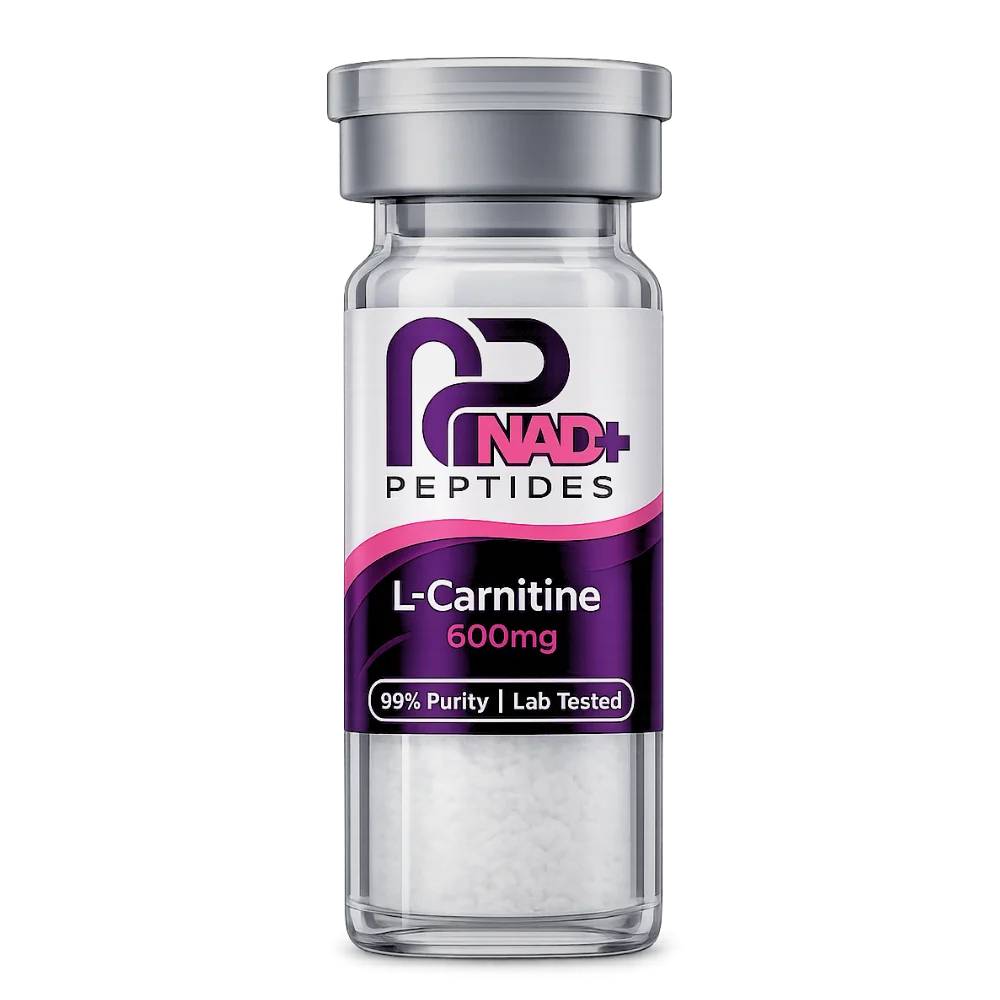
L-Carnitine 600mg
Identity
- CAS number
- 541-15-1
- Molecular formula
- C7H15NO3
- Molecular weight
- 161.20
Physical form
- Appearance
- White crystalline powder
- Purity
- 99%+ (HPLC)
- Solubility
- Freely soluble in water
Handling
- Storage
- Ambient, dry, protected from light
- Shelf life
- 36 months from date of manufacture, sealed
Also known as Levocarnitine, L-carnitine tartrate
£24.00
Quaternary ammonium compound, 600mg crystalline powder. Ambient storage, no cold chain required.
25 in stock
Supplied for laboratory research use only. Not for human or veterinary use.
- Dispatch Same day if you order before the cut off, tracked all the way
- Documentation Your batch certificate lands in your inbox the moment it ships
- Storage Ambient, dry, protected from light
Product description
A naturally occurring quaternary ammonium compound involved in the transport of long chain fatty acids across the inner mitochondrial membrane. Supplied as a 600mg vial of crystalline powder.
Research context
L-Carnitine sits in this catalogue as a metabolic substrate rather than a receptor ligand, which makes it a different kind of research tool from most of what is here. It appears in laboratory studies of mitochondrial fatty acid oxidation and in work on the carnitine shuttle specifically. It is one of the better characterised compounds in the catalogue with a long published history.
Handling notes
This is the one item here that does not require cold storage. It is a stable crystalline powder, freely soluble in water, and holds at ambient temperature in a sealed container away from light and moisture. Its stability is why the shelf life is longer than anything else on the site. Treat moisture as the main risk rather than temperature.
Worth knowing
Also referenced as levocarnitine. The L isomer is the biologically active form and the distinction from the D isomer matters when reading older literature.
Documentation
This batch ships with its own certificate of analysis showing HPLC purity and mass spectrometry identity confirmation. The batch reference is recorded against your order, so a result generated months from now can be traced back to this specific lot.
Intended use
Supplied strictly for laboratory research use. Not a medicine. Not for human or veterinary consumption, and not for any diagnostic or therapeutic use.
Research background
The short version
Carries fatty acids into mitochondria so they can be burned for energy. Without it, long chain fats cannot cross the inner mitochondrial membrane at all.
L-Carnitine is a naturally occurring quaternary ammonium compound and one of the better characterised molecules in this catalogue, with a literature going back decades. It functions as an obligatory carrier in fatty acid metabolism.
Where it came from
Isolated from muscle tissue in 1905. Its role in fatty acid transport was established through the 1950s and 1960s, and carnitine deficiency disorders are recognised clinical entities.
How it is thought to work
Long chain fatty acids cannot cross the inner mitochondrial membrane unaided. Carnitine palmitoyltransferase enzymes conjugate them to carnitine, the conjugate crosses, and the fatty acid is released for beta oxidation.
This makes carnitine availability a potential rate limiting factor in fatty acid oxidation, which is the basis for most research interest.
What it is studied for
What the published research found, and what it was tested in. We list the model against each one so you can judge how far the findings go.
- Fatty acid oxidation The carnitine shuttle and what happens to beta oxidation rates when carnitine is limited. What they found Carnitine is obligatory for long chain fatty acid transport across the inner mitochondrial membrane. Beta oxidation rates fall measurably when it is limited in isolated systems. Tested in Isolated mitochondria, cell culture
- Metabolic flux How carnitine availability affects the balance between fat and carbohydrate oxidation. What they found Carnitine availability shifts the balance between fat and carbohydrate oxidation in isolated mitochondrial preparations. Tested in Cell culture, animal models
- Carnitine deficiency Well characterised clinical disorders of the transport system. What they found Primary and secondary carnitine deficiency are recognised clinical disorders with well characterised metabolic consequences. Tested in Human clinical
Supplied for laboratory research use only. Not for human or veterinary use.
Specification
| CAS number | 541-15-1 |
|---|---|
| Molecular formula | C7H15NO3 |
| Molecular weight | 161.20 |
| Purity | 99%+ (HPLC) |
| Appearance | White crystalline powder |
| Solubility | Freely soluble in water |
| Storage | Ambient, dry, protected from light |
| Shelf life | 36 months from date of manufacture, sealed |
What you get
- The vial L-Carnitine 600mg. Sealed and labelled with the compound and its batch reference.
- Certificate of analysis For your batch specifically. Emailed when your order ships and available on this page now.
- Plain outer packaging Plain on the outside for your privacy. Everything inside is clearly labelled.
Questions about this compound
How should L-Carnitine 600mg be stored?
Store the sealed vial at Ambient, dry, protected from light. Sealed and held at that condition it carries a shelf life of 36 months from date of manufacture, sealed from the date of manufacture. Once reconstituted, shelf life shortens considerably and the solution should be aliquoted before freezing rather than thawed repeatedly.
How is L-Carnitine 600mg reconstituted?
Freely soluble in water. Add the solvent slowly down the inside wall of the vial rather than directly onto the material, then swirl gently to dissolve. Do not shake, vortex or sonicate to speed it up. A cloudy solution that will not clear usually means the wrong solvent rather than a poor batch.
What purity is this batch and how is it verified?
This item is supplied at 99%+ (HPLC), measured by high performance liquid chromatography. Identity is confirmed separately by mass spectrometry. Both results appear on the certificate of analysis for the batch you receive, not for a previous lot.
Can I see the certificate of analysis before ordering?
Yes. It is linked in the documentation section of this page. If no certificate is shown against this listing, ask before ordering rather than after.
Is L-Carnitine 600mg the same as the other names it appears under?
Yes. L-Carnitine 600mg also appears in the literature as Levocarnitine, L-carnitine tartrate. They refer to the same compound, which is worth knowing when searching for prior work because results are split across the names.
Can this be used in humans or animals?
No. This is supplied strictly as a laboratory reagent for in vitro research. It is not a medicine, it is not licensed for human or veterinary use, and it should not be administered to a person or an animal. We do not provide dosing or administration guidance.
Handy guides
- Reconstitution and solvents Choosing a solvent, adding it without damaging the peptide, working out concentrations, and the handling errors that cost people a vial.
- How to read a certificate of analysis A section by section walkthrough of a peptide certificate: what each figure means, what it does not mean, and the checks worth making before you accept a batch.
- Storage and handling Temperature, light, reconstitution and shelf life, and what actually degrades a compound in practice.