NAD+ 1000mg
Identity
- CAS number
- 53-84-9
- Molecular formula
- C21H27N7O14P2
- Molecular weight
- 663.43
Physical form
- Appearance
- White lyophilised powder
- Purity
- 99%+ (HPLC)
- Solubility
- Soluble in water
Handling
- Storage
- 2C to 8C, protected from light
- Shelf life
- 24 months from date of manufacture, sealed
Also known as Nicotinamide adenine dinucleotide, Coenzyme I, NAD
£42.00
Nicotinamide adenine dinucleotide, 1000mg. Refrigerated, not frozen. Used in mitochondrial and sirtuin research.
25 in stock
Supplied for laboratory research use only. Not for human or veterinary use.
- Dispatch Same day if you order before the cut off, tracked all the way
- Documentation Your batch certificate lands in your inbox the moment it ships
- Storage 2C to 8C, protected from light
Product description
Nicotinamide adenine dinucleotide, the coenzyme present in every living cell and central to the redox reactions that drive cellular metabolism. Supplied as a 1000mg vial.
Research context
NAD+ is usually the starting point for laboratory work on cellular energy metabolism. It appears across studies of mitochondrial function, sirtuin activity and the DNA repair pathways that consume it. The distinction between NAD+ and its precursors, NMN and NR, matters when reading the literature, because the three are frequently discussed as though interchangeable and behave differently in an assay.
Handling notes
This is the compound most often stored incorrectly in this catalogue. NAD+ is a refrigerated item at 2C to 8C, not a frozen one, and it is put in a freezer regularly because everything arriving in the same box goes in there. It is freely water soluble and dissolves quickly. Protect from light and from moisture, and keep the vial sealed until you need it.
Worth knowing
The 1000mg format exists because NAD+ is typically used at higher quantities than the peptides in this catalogue, and repeated small orders create a traceability problem across a long protocol.
Documentation
This batch ships with its own certificate of analysis showing HPLC purity and mass spectrometry identity confirmation. The batch reference is recorded against your order, so a result generated months from now can be traced back to this specific lot.
Intended use
Supplied strictly for laboratory research use. Not a medicine. Not for human or veterinary consumption, and not for any diagnostic or therapeutic use.
Research background
The short version
The starting point for most mitochondrial and ageing research, and one of our most ordered products. NAD+ is a coenzyme every living cell uses for energy production, and it is also consumed by the enzymes that repair DNA and regulate ageing related genes.
NAD+ is not a research peptide but a coenzyme present in every living cell, and the literature on it is correspondingly large and considerably older than anything else in this catalogue. It sits here because it is a standard reagent in mitochondrial and metabolic work.
Where it came from
Characterised in the early twentieth century as a cofactor in fermentation. Its role in redox reactions has been textbook biochemistry for decades. The current research interest concerns its consumption by enzymes including sirtuins and PARPs, and what happens to cellular pools when that consumption is high.
How it is thought to work
NAD+ cycles between oxidised and reduced forms, carrying electrons in the reactions that generate cellular energy. It is also consumed as a substrate rather than recycled by sirtuins, PARPs and CD38, which links its availability to DNA repair and to transcriptional regulation.
A practical point for study design: NAD+, NMN and NR are frequently discussed as interchangeable and behave differently in an assay. Which one a protocol specifies matters.
What it is studied for
What the published research found, and what it was tested in. We list the model against each one so you can judge how far the findings go.
- Mitochondrial bioenergetics The redox role, and how the ratio of oxidised to reduced forms tracks metabolic state. What they found The oxidised to reduced ratio tracks metabolic state and is used as a direct readout of it. Depletion in culture reduces measured respiration rate. Tested in Cell culture, isolated mitochondria
- Sirtuin activity Sirtuins consume NAD+ as a substrate, which makes availability a limiting factor in their activity. A substantial share of the ageing literature runs through this observation. What they found Sirtuin activity is substrate limited by NAD+ availability. Repletion in culture restores deacetylase activity in depleted systems. Tested in Cell culture, model organisms
- DNA repair pathways PARP enzymes consume NAD+ during repair, and heavy repair activity draws down cellular pools. What they found PARP activation during repair consumes cellular NAD+, and heavy repair activity measurably draws down the pool. This is the link most of the ageing literature runs through. Tested in Cell culture
Further reading
- NAD+ metabolism and its roles in cellular processes during ageing Read the paper
Supplied for laboratory research use only. Not for human or veterinary use.
Specification
| CAS number | 53-84-9 |
|---|---|
| Molecular formula | C21H27N7O14P2 |
| Molecular weight | 663.43 |
| Purity | 99%+ (HPLC) |
| Appearance | White lyophilised powder |
| Solubility | Soluble in water |
| Storage | 2C to 8C, protected from light |
| Shelf life | 24 months from date of manufacture, sealed |
What you get
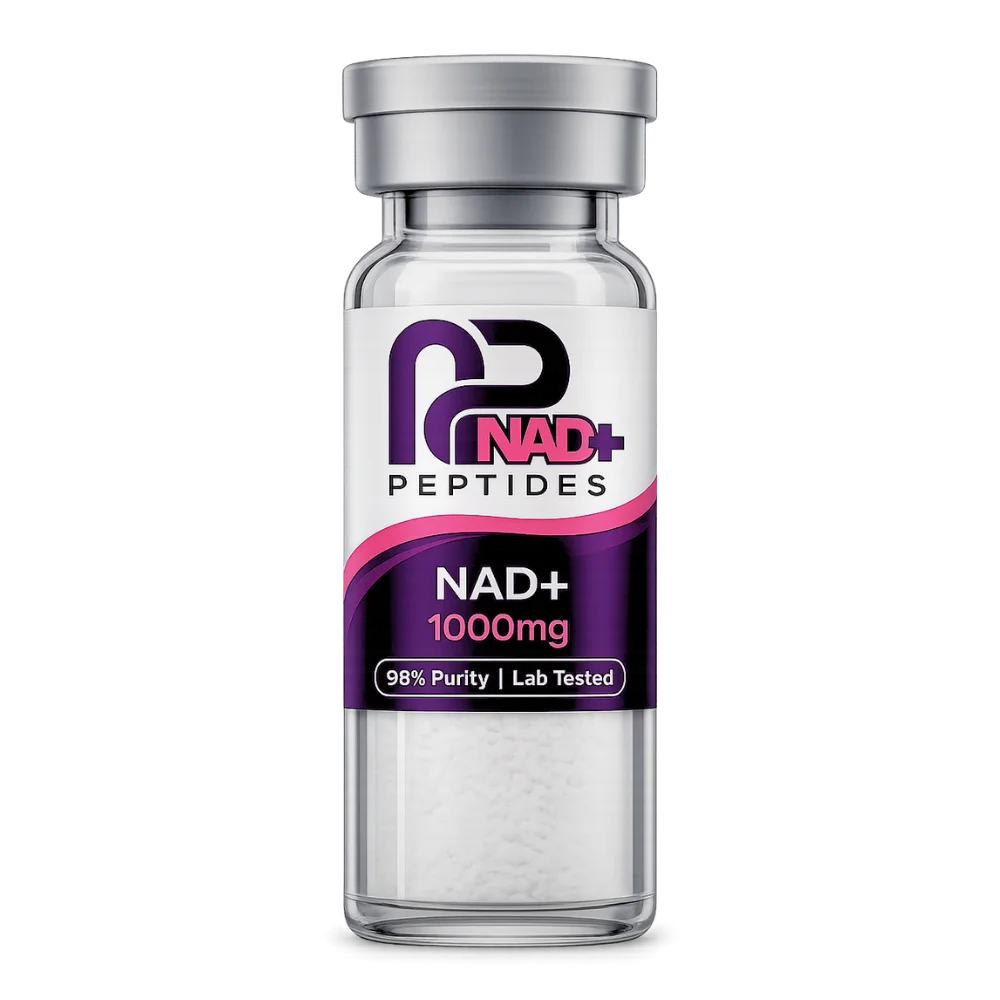
- The vial NAD+ 1000mg. Sealed and labelled with the compound and its batch reference.
- Certificate of analysis For your batch specifically. Emailed when your order ships and available on this page now.
- Cold chain packaging Gel pack and insulation. We ship these early in the week so nothing sits in a depot over the weekend.
- Plain outer packaging Plain on the outside for your privacy. Everything inside is clearly labelled.
How it compares
How this compares to the compounds people usually weigh it against. Only the specs that actually differ are shown.
| Specification | SS-31 10mg | MOTS-c 50mg | This product NAD+ 1000mg |
|---|---|---|---|
| Molecular weight | 639.79 | 2174.62 | 663.43 |
| Solubility | Soluble in bacteriostatic water | Soluble in bacteriostatic water | Soluble in water |
| Storage | -20C, protected from light | -20C, protected from light | 2C to 8C, protected from light |
| Price | £58.00 | £46.00 | £42.00 |
Questions about this compound
How should NAD+ 1000mg be stored?
Store the sealed vial at 2C to 8C, protected from light. Sealed and held at that condition it carries a shelf life of 24 months from date of manufacture, sealed from the date of manufacture. Once reconstituted, shelf life shortens considerably and the solution should be aliquoted before freezing rather than thawed repeatedly.
How is NAD+ 1000mg reconstituted?
Soluble in water. Add the solvent slowly down the inside wall of the vial rather than directly onto the material, then swirl gently to dissolve. Do not shake, vortex or sonicate to speed it up. A cloudy solution that will not clear usually means the wrong solvent rather than a poor batch.
What purity is this batch and how is it verified?
This item is supplied at 99%+ (HPLC), measured by high performance liquid chromatography. Identity is confirmed separately by mass spectrometry. Both results appear on the certificate of analysis for the batch you receive, not for a previous lot.
Can I see the certificate of analysis before ordering?
Yes. It is linked in the documentation section of this page. If no certificate is shown against this listing, ask before ordering rather than after.
Is NAD+ 1000mg the same as the other names it appears under?
Yes. NAD+ 1000mg also appears in the literature as Nicotinamide adenine dinucleotide, Coenzyme I, NAD. They refer to the same compound, which is worth knowing when searching for prior work because results are split across the names.
Can this be used in humans or animals?
No. This is supplied strictly as a laboratory reagent for in vitro research. It is not a medicine, it is not licensed for human or veterinary use, and it should not be administered to a person or an animal. We do not provide dosing or administration guidance.
Handy guides
- Reconstitution and solvents Choosing a solvent, adding it without damaging the peptide, working out concentrations, and the handling errors that cost people a vial.
- Storage and handling Temperature, light, reconstitution and shelf life, and what actually degrades a compound in practice.
- Freeze thaw cycles and shelf life What degrades a peptide in practice, how much a freeze thaw cycle actually costs you, and how to plan aliquots so it stops mattering.
- How to read a certificate of analysis A section by section walkthrough of a peptide certificate: what each figure means, what it does not mean, and the checks worth making before you accept a batch.